
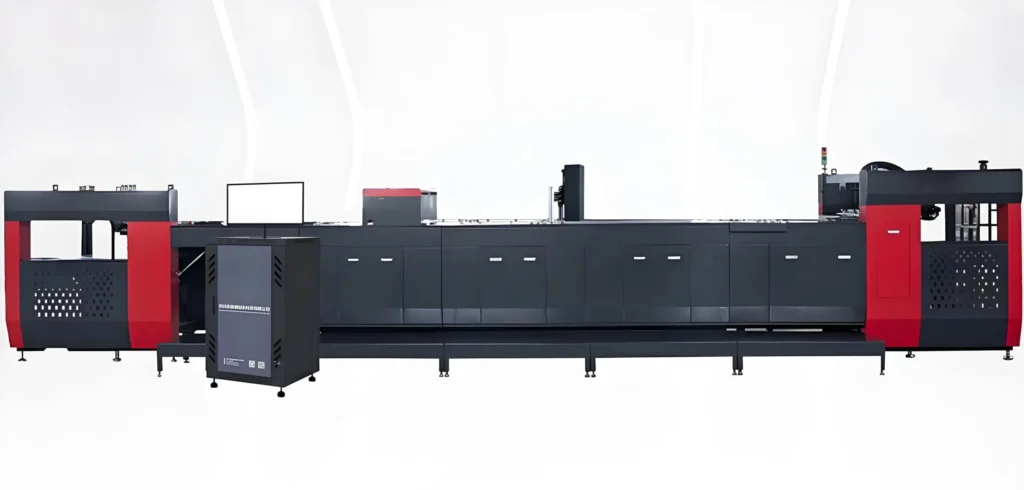
UV ink, therefore, becomes very valuable in glass printing. The major attributes of this type of ink include its ability to cure at high speeds under exposure to ultraviolet light. The entire process is fast and efficient. The other attributes are that they are environmentally friendly and do not contain any solvents. They also have excellent adhesion as well as abrasion resistance, which puts them at appropriate use levels for demanding requirements such as glass printing applications. This paper will discuss the application of both Cationic and Free Radical systems, in turn giving an overview of their advantages over one another within the UV-curable product technology for glass printing.
I. Types and Principles of UV Inks
Ultraviolet curable inks solidify rapidly under ultraviolet light. The curing process uses the energy of ultraviolet light to trigger a chemical reaction, rapidly polymerizing the ink components to form a hard film. This technology offers significant advantages in glass printing, such as fast drying, high gloss, excellent adhesion, and chemical resistance. Cationic UV formulations utilize cationic initiators that begin the polymerization of monomers, most particularly epoxy resins or vinyl ethers. Though the curing of these solutions takes somewhat longer, it affords excellent deep-curing properties and hence may be used when printing thick layers. These formulations have minimal challenges with oxygen inhibition during the curing process; therefore, curing remains stable even in thick layers. Monomers and prepolymers are readily initiated by free-radical initiators. These printing solutions have fast curing suitable for thin layer printing. One major drawback with free-radical ultraviolet inks is that they are highly susceptible to an oxygen inhibition effect during curing, which leads to the layer not being fully cured; hence, adhesion and abrasion resistance are not attained.
II. Application of UV Inks in Glass Printing
Glass, as a printing substrate, features a smooth surface, high hardness, and strong chemical stability. Glass printing places high demands on ink adhesion, abrasion resistance, chemical resistance, and gloss. Cationic UV-curable products are used in glass printing for applications such as glass bottles and decorative glass panels. These formulations are suitable for printing thick layers, providing excellent adhesion and abrasion resistance. Their deep curing properties make them excellent for thick layers, effectively preventing adhesion issues caused by uncured areas within the applied layer. Examples of free radical ultraviolet applications in glass printing include glass labels and glass crafts. These solutions are suitable for printing thin layers, significantly shortening print cycles and improving production efficiency.
However, free radical formulations may not achieve the deep curing effect of cationic options in thick layer printing, so the selection process requires careful consideration based on specific printing requirements.
III. Comparison of Cationic and Free Radical UV Inks
- Curing Speed
Free Radical UV Inks: These inks are known for their fast curing speed, making them particularly suitable for thin layer printing. This rapid curing process significantly enhances production efficiency, allowing for quicker turnaround times and higher output.
Cationic UV Inks: While these inks have a slower curing speed compared to their free radical counterparts, they offer excellent deep-curing properties. This makes them ideal for thick layer printing, ensuring that the ink penetrates deeply and provides a durable, high-quality finish.
- Adhesion and Abrasion Resistance
Cationic UV Inks: These inks provide superior adhesion and abrasion resistance, especially when used in thick layer printing. Their deep-curing properties ensure that the ink bonds strongly to the substrate, resulting in a durable and long-lasting print.
Free Radical UV Inks: These inks also offer good adhesion and abrasion resistance, particularly in thin layer printing. However, their performance in these areas is generally not as strong as that of cationic inks when used in thick layers.
- Cost
Free Radical UV Inks: Generally, free radical UV inks are less expensive than cationic UV inks. This makes them a cost-effective choice for applications where thin-layer printing is sufficient and rapid curing is a priority.
Cationic UV Inks: Cationic UV inks tend to be more expensive due to their advanced formulation and superior deep-curing properties. This higher cost is justified by their ability to provide excellent adhesion and durability in thick-layer printing applications.
In actual practice, the decision depends on the process and equipment conditions. Ultraviolet curable technology has broad application prospects in glass printing. Cationic formulations work well for thick layers. They offer strong adhesion and resistance to wear. On the other hand, free radical options cure quickly and boost production speed. Printers can choose the right UV-curable solution based on their needs. This helps them get the best print quality and save money. As technology keeps improving, УФ-краски will be used more in glass printing. This will lead to more chances for innovation and growth in the industry.